
Once known for its great industrial tradition, Oberhausen has successfully embarked on a new path by initiating an urban renewal programme. As a result, the city has earned a new interesting image owing in particular to the Neue Mitte and CentrO – the most modern shopping and leisure centre in Europe.
Oberhausen now serves as a prime example for the structural change of an entire region. The Neue Mitte with CentrO, the Gasometer and other projects attracts more than 23 million visitors to the Ruhr region every year.With roughly 220,000 inhabitants, Oberhausen is one of the medium-size cities located in the Ruhr region. In 1758 the Ruhr’s first modern iron smeltery, the St. Antony-Hütte, was founded in the area of the neighbourhood now known as Osterfeld.
Nonetheless, Oberhausen itself is a young city. The rural community of Oberhausen was first established in 1862 and received its charter in 1874. The current urban area evolved in 1929 when the towns Sterkrade, Osterfeld and Oberhausen, which were independent until then, were combined.
Constantly quarrelling with the industry about specific areas, Oberhausen successfully implemented a number of outstanding solutions in terms of urban development and regional planning. One of the first city planning achievements is the grid pattern of streets and city blocks in Oberhausen’s old city centre (Alt-Oberhausen). Here you’ll find the Marktstraße, which is a shopping promenade, extending over one kilometer with plenty of department stores, specialty shops and cafés.
Side streets also offer many other worthwhile destinations for shopping excursions. The lower end of the Marktstraße follows a strict geometric plan up to Altmarkt – Oberhausen’s marketplace. Under the Siegessäule (victory column) with its Friedensengel (angel of peace), you’ll find merchants selling their goods every day.Marktstraße, Elsässer Straße and Altmarkt have all been remodelled, which in turn has significantly enhanced the city centre. Located not far from the main station is the BERO-Einkaufszentrum, a shopping centre that offers everything under one roof. With a sales area covering 45,000 m2 and an excellent mixture of every day items and convenience goods, it attracts on average 22,000 visitors on a daily basis.
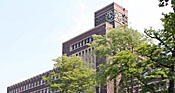
The city centre also contains the most important building of Oberhausen’s brick Expressionism period – the Bert-Brecht-Haus. Designed by Otto Scheib, an architect from Cologne, and erected in 1928, it resembles the Chile-Haus, which was built five years before it in Hamburg. The Bert-Brecht-Haus is home today to the Volkshochschule (adult education centre) and the Stadtbibliothek (municipal library). Other buildings that were erected during the 1920s include the Hauptbahnhof (main station) and the Rathaus (town hall).Sterkrade and Osterfeld, which were both independent towns until 1929, have evolved into thriving neighbourhoods. Both have attractive pedestrian zones with a wide variety of department stores, boutiques, cafés and restaurants.Oberhausen is known all over the globe because of its short film festival.
Since 1954 film directors and journalists from all four corners of the world have been gathering in Oberhausen every year. The cosmopolitan outlook of the International Short Film Festival has characterised Oberhausen’s reputation for more than 40 years.The Ludwig Galerie Schloss Oberhausen is also important nationally. It includes, among other things, a significant collection of works of art that were created during the 40-year period when Germany was divided.Sports are one of the most popular recreational activities in Oberhausen, which has 223 sports clubs with 48,000 members.
You’ll also find professional teams in Oberhausen, not only in football and tennis, but other disciplines as well, competing in the upper leagues.If you would rather enjoy a relaxing walk outdoors in parks, Oberhausen is perfect. Approx. one third of Oberhausen consists of woods, park areas and bodies of water. Some of the most popular destinations are the Revierpark Vonderort, the Kaisergarten next to the Schloss with its small zoo, the Hiesfelder Wald and the Sterkrader Wald (woods).
You’ll even find today various, albeit partially hidden, traces of early history that left its mark on some parts of the city. For instance, the Burg Vondern is one of the most impressive secular structures of the Gothic period located north of the Main River. The Kastell Holten is a medieval estate built of stone and part of an old border defence structure erected by Graf Engelbert von der Mark in the region.